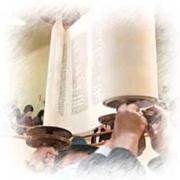





The Symbol of Loyalty
In Parashat Nasso 5:11-31, Hashem tells about a woman who is suspected of adultery by her husband. I assume you know the details... So the husband takes her to the Bet Hamikdash to see a Cohen for the test. A Cohen gives her a drink of bitter waters; if she is guilty, she dies there, but if she is not, she is blessed with a child.
We have another incident of the bitter waters in a different parsha. In Parashat Beshalach 15:23-25, right after the Am Yisrael goes through the Yam Suf, the nation becomes thirsty, but couldn't drink the waters of the Marah, since they were bitter. So they asked Moshe, who, in turn, asked Hashem. And Hashem showed him a piece of wood, which he threw into the water, and it became sweet. And.. the nation drank.
There's something about this piece of wood. So, let's look at it closely.
Have you ever wondered why Aron HaKodesh or the Holy Ark looks this way? - click here
In Parashat Terumah, we are told about the details of the Holy Ark. A wooden box covered with gold from the inside out. On the box cover, there are two golden figures of angels—Keruvim—facing each other, their wings spread forward. Inside the box are two sets of Luchot - the 10 Commandments. And on the side of the box, two golden loops on each side, through which wooden poles covered with gold were inserted. The ends of each pole are wider than the openings of the loops, so the poles cannot be inserted through the loops. The Zohar says a miracle occurs, and the poles pass through the loops miraculously.
It is a very holy and mystical structure, where every part of it represents something.
The tablets containing the 10 Commandments inside the box represent a Ketuba, a marriage contract. When a man and a woman get married, they receive a Ketuba; the 10 Commandments are a Ketuba between the nation of Israel and Hashem, since on Shavuot, when we receive the Torah, Hashem marries the nation of Israel.
Each wedding ceremony or chupa has 2 witnesses, and the two Keruvim—the golden angels atop the Holy Ark — also serve as witnesses. Every time Cohen HaGadol enters Kadosh Kedoshim on Yom Kippur, based on certain signs of the Keruvim, he determines whether Hashem is happy with the way the nation is leading its way of life.
The wooden poles on the sides of the Holy Ark are covered in gold, symbolizing man and woman, or, to be exact, a husband and wife. Why are the poles covered in gold, you ask? Simple... What is Tzeniut or Modesty? When a couple follows the laws of modesty in front of Hashem, they are covered in gold. But, by uncovering themselves or dressing immodestly, they are displaying their wooden-like bodies, since wood and the human body are physical products of Earth, which makes them appear lowly in G-d's eyes.
So, there you have it - two wooden poles, covered in gold, miraculously inserted into the rings, as the Zohar says. The Torah adds: And the poles shall never be removed... But suppose the wife removes her golden wrapping, abandons her position on the Holy Ark, and is suspected of having relations with someone other than her husband. In that case, the Torah requires her to undergo a test with bitter water. If she is guilty, she dies; if she is not guilty, she is blessed with a child, and Hashem wraps her back in gold and restores her to her former position.
And this makes the Holy Ark a symbol of Loyalty between Husband and Wife or between the Nation of Israel and Hashem.
The Midrash says that Leviyim carried the Holy Ark by holding the poles on either side. Further, it adds that it is not the Leviyim who carried the Ark, but it is the Holy Ark that carried the Leviyim in the desert.
So it is, with the husband and the wife. When the couple gets married or later in life, they dedicate their lives, their whole existence, to Kabbalat Ol Malkhut Shamayim – Accepting the Kingship of Heaven, by following G-d's laws and leading a family based on Torah values. And just as the Ark that carries the Leviyim, in the same way, it is not the couple that carries the burden of the Kingship of Heaven, but the Kingship of Heaven carries the couple through their journey of life, by overflowing them with holiness, abundance, and constant miracles.
Shmuel Katanov
(The Bitter Waters of the Sotah)